Running a Real-Time Business on Rearview Systems
Across the logistics sector, operational systems have failed to keep pace with network complexity. Transportation Management Systems (SAP TM), Warehouse Management Systems (WMS), carrier portals, customer EDI channels, and financial accounting suites frequently function as isolated silos even within non-integrated logistics ERP setups.
The consequences compound across every shipment:
- Fragmented Infrastructure: Creates redundant manual data entry, missed tracking exceptions, and settlement disputes.
- Delayed Margin Visibility: Financial insights often arrive weeks after freight has already moved, masking profit erosion until month-end close.
- Workforce Deficits: The Global Driver Shortage Report by the World Road Transport Organization (IRU) highlights around 2.9 million unfilled truck driver positions representing 11% of the total workforce across 18 key markets. This structural deficit makes carrier capacity scarcer, costlier, and increasingly difficult to commit against service promises.
The EcoTech Perspective: Automation built on top of fragmented data simply accelerates and multiplies operational chaos. True autonomous workflows require a clean-core SAP ® foundation where data flows seamlessly between order entry, transport planning, and final billing.
Modernization can no longer wait for the next budget cycle or rate correction. Providers that move deliberately now to transform their operations within their SAP environment will absorb market shocks far better than those waiting for a perfect moment.
What Does the SAP Autonomous Enterprise Actually Mean for LSPs?
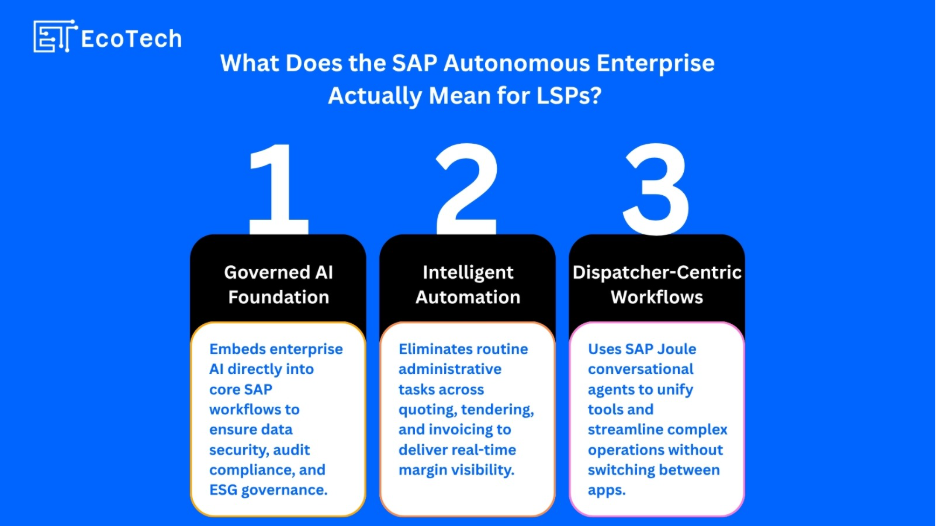
The SAP autonomous enterprise in logistics is not a single off-the-shelf software package. It is an operating framework that redefines how people, operational workflows, SAP Business Data Cloud / SAP S/4HANA systems, and enterprise AI tools interact across a provider’s core network.
1. A Governed AI Foundation Built on Trust
For logistics leaders focused on risk-managed innovation, foundation precedes application. An enterprise SAP AI architecture connects business intelligence, SAP S/4HANA operational logic, and compliance rules directly into existing core workflows. In an industry built on customer trust, where contracts carry strict audit terms and ESG rules flow down the supply chain, data stewardship and AI governance become vital competitive advantages.
2. Freight Cost Automation & Settlement from Quote to Cash
Freight tendering, exception management, carrier invoice reconciliation, transport cost planning, and monthly financial closes in SAP Financials are primary candidates for intelligent automation. The objective is not to replace experienced dispatchers or analysts, but to eliminate high-volume, routine administrative work. When operational teams spend less time chasing status updates across email threads, margin visibility shifts from monthly retrospectives to real-time analytics.
3. Systems That Work the Way Dispatchers Think
Staff no longer need to toggle between SAP TM, carrier portals, and external spreadsheets to resolve issues. Instead, they can state their intended outcome directly using SAP Joule or conversational enterprise agents. Intelligent tools then orchestrate the underlying SAP modules, data flows, and external APIs to achieve the desired outcome. This reduces onboarding friction and boosts talent retention in tight labor markets.
Three Pressures, One Root Cause
Thin margins, operational blind spots, and unallocated carrier capacity are frequently treated as separate operational fires. In reality, they all stem from a single systemic vulnerability: an outdated operating infrastructure that generates more administrative overhead than actionable insight.
Manual rate sheet reconciliation and carrier verification across disparate portals slow down response times. As a result, cost leakage increases and profit margins erode before billing even occurs. Solving these three pressures requires unifying data streams within a centralized enterprise architecture.
High-Value Starting Points for SAP Logistics Transformation
To build momentum, logistics technology leaders should focus on operational areas where the gap between manual effort and automation potential is greatest:
- Freight Margin & Settlement: Automating freight cost reconciliation and accrual-to-settlement matching in SAP TM and FI frees finance teams to focus on strategic analysis while catching cost leakage early.
- Exception & Disruption Management: Connecting real-time signals across carriers and modes within SAP Business Technology Platform (BTP) shifts operations from reactive troubleshooting to proactive disruption resolution.
- Transport Cost Planning: Establishing unified cost views across lanes and modes allows LSPs to model profitability in SAP before committing carrier capacity.
- Workforce & Capacity Optimization: Unified operational data streamlined by AI reduces manual coordination per shift, helping existing teams manage higher volume smoothly.
Regional Logistics Realities: Navigating KSA, Egypt, and Kuwait
Deploying SAP Transportation Management in Saudi Arabia, Egypt, Kuwait, and the wider MENA region demands more than standard global templates. LSPs operating in these markets face distinct operational and regulatory environments:
- Cross-Border Corridor Complexity: Navigating customs procedures, land transport clearing hubs, and regional port handoffs across GCC and North African trade corridors requires real-time documentation synchronization within SAP TM.
- Mandatory E-Invoicing Compliance: Seamless integration with national tax platforms such as ZATCA Phase 2 (Fatoora) in Saudi Arabia and ETA e-invoicing in Egypt which is essential for immediate freight billing validation and compliant revenue recognition.
- Vision 2030 & Logistics Hub Expansion: Rapid infrastructure growth in KSA and Kuwait requires flexible ERP setups that rapidly onboard third-party carriers, fleets, and regional warehouse networks.
Why Implement Advanced SAP Solutions with EcoTech?

Maximizing your return on investment with advanced SAP technologies requires an implementation partner who understands both cutting-edge global software architecture and regional operational realities. At EcoTech, we combine decades of enterprise experience with a hands-on, partnership-driven approach to ensure your digital transformation succeeds.
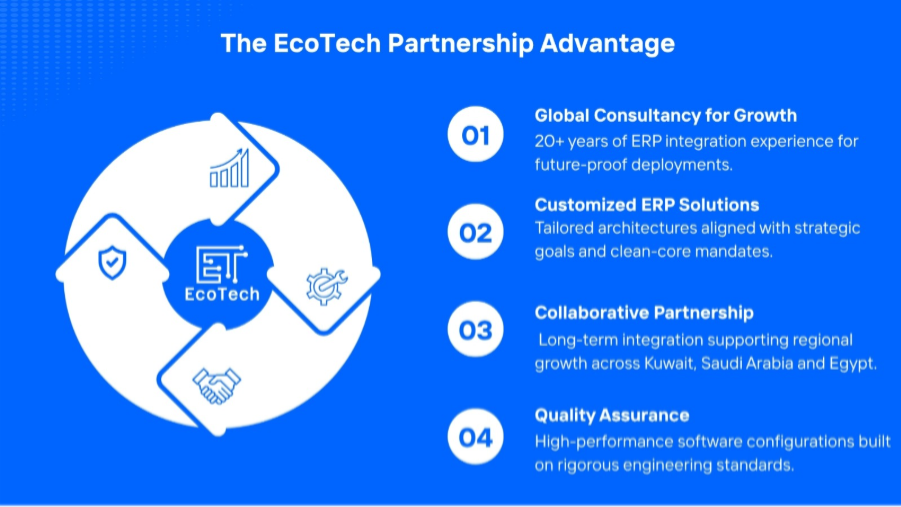
- Global Consultancy for Growth: Leveraging over 20 years of ERP and SAP integration experience to deliver seamless, future-proof platform deployments.
- Customized ERP Solutions: Delivering tailored application architectures and extensions that address your organization’s precise strategic goals and clean-core mandates.
- Collaborative Partnership: Fostering long-term relationships by integrating directly into your ongoing business growth journey across Saudi Arabia, Egypt, Kuwait, and the broader region.
- Quality Assurance: Guaranteeing reliable, high-performance software configurations through rigorous engineering standards and deep ecosystem expertise.
Is your logistics operation ready to move beyond manual workarounds and fragmented systems?
Book your free discovery session
Frequently Asked Questions (FAQ)
What is SAP TM (Transportation Management)?
SAP TM (Transportation Management) is an enterprise logistics application for end-to-end transportation processes. It manages freight planning, carrier tendering, execution tracking, and freight settlement. Integrated into SAP S/4HANA, it optimizes transport costs and improves supply chain visibility.
Can SAP automate freight settlement and cost reconciliation?
Yes. SAP TM automates freight charge calculations, cost accruals, invoice verification, and dispute management. By linking operational transport data directly to SAP Financials (FI), LSPs eliminate manual rate checking and reduce billing leakage.
Do logistics service providers (LSPs) need SAP S/4HANA to build an autonomous enterprise?
LSPs can start by optimizing standalone SAP TM or SAP BTP extensions. However, transitioning to SAP S/4HANA provides the unified data model and real-time analytics needed for full autonomous workflows and AI integration.