Your Supply Chain Isn’t Slow Because of Software
Most supply chain problems we’re called in to fix look like technology problems. The forecast is wrong, stock sits in the wrong warehouse, and trucks leave half empty. So companies buy a planning tool.
Six months later, the forecast is still wrong. The tool was fine. It was planning on lead times nobody had updated in years, units of measure that differed between purchasing and the warehouse, and approvals that lived in WhatsApp.
Supply chain optimization with SAP® delivers real results: lower inventory, fewer stockouts, and faster delivery. But it only works when it’s applied to a value chain that has been understood, redesigned, and cleaned first. That’s why EcoTech runs every supply chain project through the same five stages, in the same order.
Where Supply Chains Really Break
Across manufacturing, retail, and distribution clients, optimization projects stall at the same three points:
- Data that lies: Duplicate vendors, wrong units of measure, outdated bills of materials, and lead times that were never maintained. The system then plans with confidence and gets it wrong.
- Processes that live outside the system: Safety stock overrides in Excel, urgent orders agreed by phone, expediting rules in one planner’s head. Software can only follow rules that are written down.
- Alerts nobody owns: A planning tool flags a supplier delay or a coming stockout. If no one is named to act, the alert is ignored and the tool gets blamed.
Each of these is fixed at a specific stage of the value chain, before the technology is switched on.
The EcoTech Value Chain: Five Stages
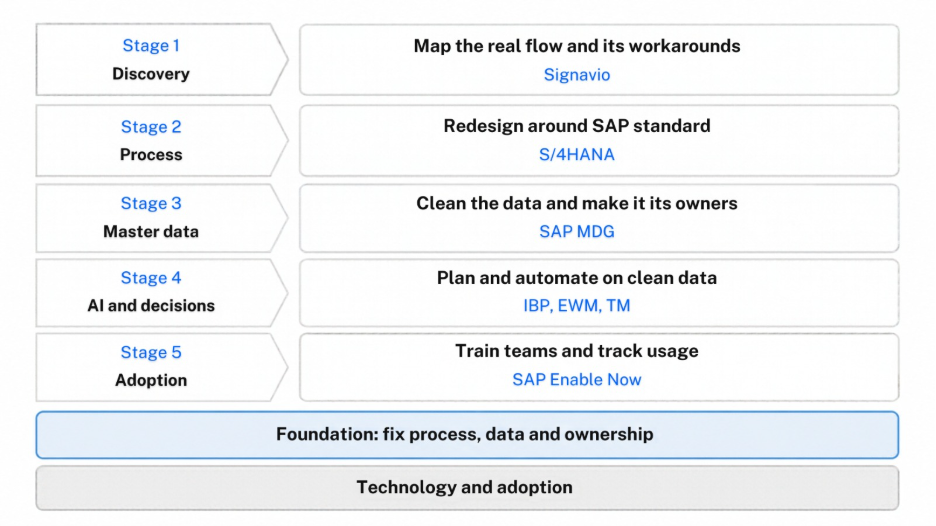
The order is the point. Stages 1 to 3 fix the process, data, and ownership gaps. Only then does stage 4 add SAP planning and automation, and stage 5 makes sure people actually use it.
- Business Discovery: We map how orders, stock, and deliveries really move today, including every workaround, delay, and manual handoff. (SAP Tool: SAP Signavio Process Intelligence)
- Process Re-Engineering: We redesign those workflows around SAP standard processes, removing unnecessary steps before anything is configured. (SAP Tool: SAP S/4HANA Standard Processes & Signavio Process Manager)
- Master Data Management: We clean material, vendor, customer, and BOM data, and give each data set a named owner so it stays clean. (SAP Tool: SAP Master Data Governance – MDG)
- AI and Decision Enablement: We switch on forecasting, inventory optimization, warehouse, and transport automation on top of the clean foundation. (SAP Tools: SAP IBP, SAP EWM, SAP Transportation Management, SAP Business Network)
- Change and Adoption: We train planners, warehouse teams, and managers, then track usage and KPIs until the new way of working sticks. (SAP Tool: SAP Enable Now & Embedded Analytics)
Which SAP Solution Fits Each Stage
Each stage of the value chain has a matching SAP tool. Buying stage-4 tools before stages 1 to 3 are done is the most common way supply chain budgets get wasted.
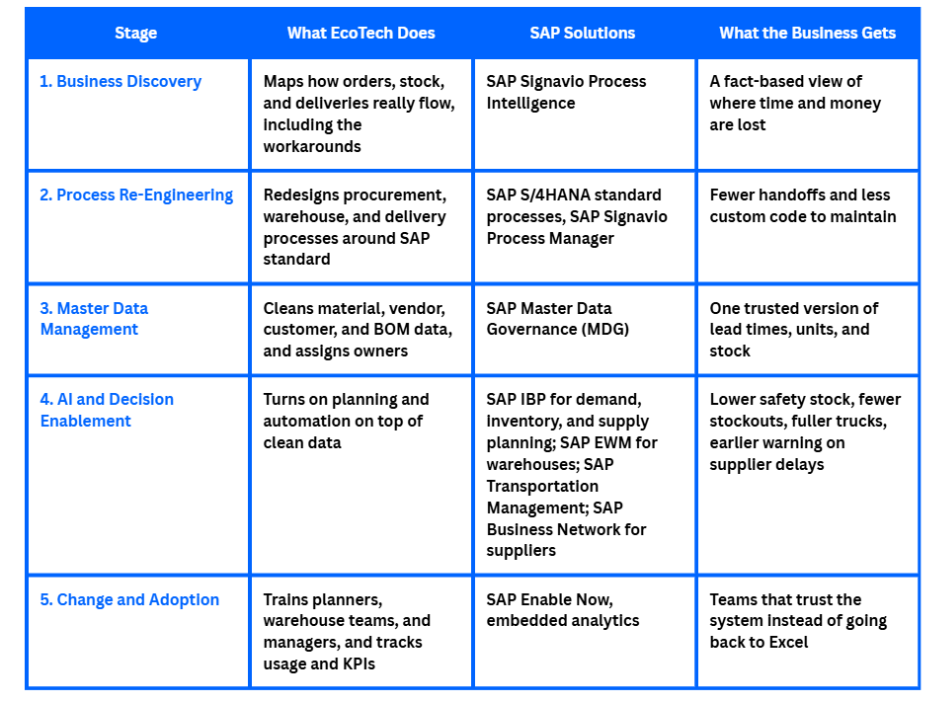
Not every company needs every tool. A mid-size distributor may get most of the value from stages 1 to 3 plus standard S/4HANA planning, without IBP at all.
What’s Different About Supply Chains in Saudi Arabia, Egypt, and Kuwait
Global SAP guides assume stable currencies, short lead times, and one legal entity. Regional supply chains rarely have any of those.
- Import-heavy, long lead times: Many regional manufacturers and distributors depend on imported materials, with lead times that change shipment by shipment. Static lead times in the system are the first thing that breaks planning. Stage 3 fixes the data; stage 4 plans with real variability.
- Currency swings in Egypt: When import costs move quickly, landed cost and reorder decisions need daily data, not month-end reports. This makes clean master data and real-time stock visibility worth far more than in stable markets.
- Growth across borders: Groups expanding from Egypt into KSA, or across the GCC, often run each entity differently. Discovery and process redesign (stages 1 and 2) set one standard before rollout, instead of copying each country’s workarounds into SAP.
- Local compliance in the flow: E-invoicing under ZATCA in Saudi Arabia and ETA in Egypt touches every sales and purchase transaction. It belongs in the process design, not as an add-on after go-live.
The pattern is the same: regional complexity makes skipping stages 1 to 3 more expensive, not less.
Why EcoTech for Supply Chain Optimization with SAP

EcoTech is an SAP Silver Partner with more than 20 years of ERP experience across Saudi Arabia, Egypt, and Kuwait. What makes us different is the order we work in.
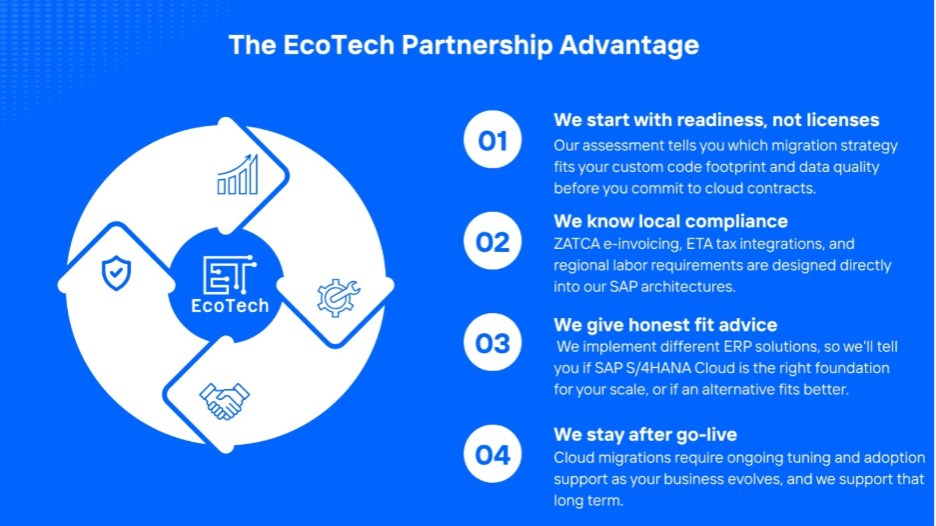
- Value chain first, licenses last: We don’t recommend an SAP tool until stages 1 to 3 show what your operation actually needs.
- One team across all five stages: The people who map your process also clean your data and configure SAP. Nothing gets lost between a strategy firm and an implementer.
- Honest fit advice: We implement SAP and Odoo, so if SAP S/4HANA or IBP is more than your business needs, we’ll say so. Learn more about our SAP S/4HANA implementation services and Odoo ERP solutions.
- Adoption is part of delivery: Stage 5 is in every plan and every budget, not an optional extra.
Start With Stage 1: A Free Supply Chain Discovery Session
In 30 minutes, we’ll walk through your order-to-delivery flow and show you where the biggest losses are, which stage you’re really at, and what to fix first. You’ll leave with a clear starting point, whether or not you choose SAP.
Book your free discovery session
Frequently Asked Questions
What is supply chain optimization with SAP?
It means using SAP tools such as SAP IBP, SAP EWM, SAP Transportation Management, and SAP Business Network to plan demand, stock, production, and delivery on one shared set of data. It works best after processes and master data are standardized.
Where should a company start?
With discovery, not software. Map how orders, stock, and deliveries really move today, including workarounds. That shows which problems need new tools and which need process or data fixes.
Do I need SAP IBP?
Not always. IBP is valuable for complex, multi-site planning. Many mid-size companies get most of the benefit from clean master data and standard SAP S/4HANA planning first.
Can we optimize the supply chain before moving to SAP S/4HANA?
Yes. Discovery, process redesign, and data cleanup (stages 1 to 3) can start on any system, and they make the later move to S/4HANA faster and cheaper.
How long does it take to see results?
Discovery takes weeks, not months. Data and process fixes often show results in inventory and service levels before any new planning tool goes live.
Why do supply chain optimization projects fail?
Most fail because of inaccurate master data, undocumented processes, and alerts nobody owns but not because of the software.