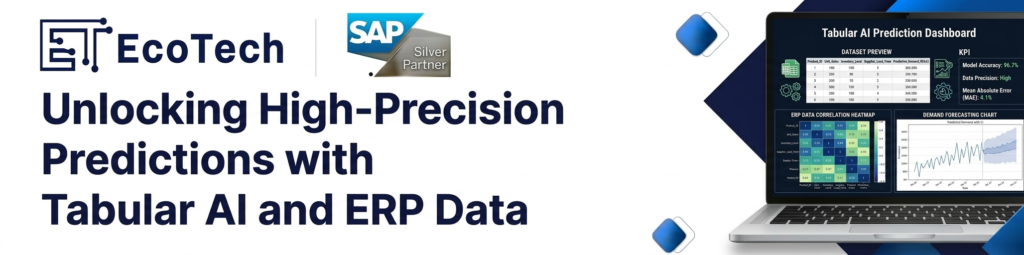
Organizations today rely heavily on predictions to forecast demand, optimize supply chains, manage financial risk, and make mission-critical business decisions. While large language models (LLMs) dominate technology headlines, the true backbone of modern enterprise intelligence remains structured data.
Stored across enterprise resource planning (ERP) platforms, relational databases (RDBs), and spreadsheets, structured data provides the foundational context required for accurate business forecasting. However, capturing its full value requires moving beyond language-centric AI and leveraging specialized tabular AI models.
What Is Structured Data and How Is It Organized?
Structured data refers to information organized into predefined fields, records, and schemas. Its standardized format enables enterprise applications to process large volumes of transactions efficiently and provides artificial intelligence models with recognizable patterns.
Structured business data is built on three core structural elements:
- Fields: Standardized individual attributes (e.g., invoice amounts, payment dates, supplier IDs).
- Records: Groupings of related fields representing a single entity or event (e.g., a customer profile or transaction record).
- Relationships: Logical connections across distinct records and enterprise tables (e.g., linking a purchase order to its corresponding invoice and payment record).

While structured data provides operational context, structure alone does not guarantee valuable insights. Predictive success depends on data accuracy, accessibility, governance, and selecting an AI architecture designed specifically for tabular environments.
Why Modern Business Systems Depend on Structured Business Data
Core enterprise systems, particularly ERP platforms, rely on structured business data to execute day-to-day operations and automate multi-step workflows across functions.
Because structured data follows uniform formats, enterprise applications can trigger cascading actions across operations:
- A sales order is logged in the system.
- The system initiates an automated inventory check.
- Production planning schedules necessary manufacturing tasks.
- An invoice is generated for the customer.
- The transaction automatically updates the corporate financial forecast.
This continuous record-keeping establishes historical baselines, allowing business leaders to evaluate past performance, detect operational anomalies, track real-time conditions, and plan future outcomes.
Why Language-Centric LLMs Struggle with Structured Data
Large Language Models excel at understanding, summarizing, and generating natural language text. However, applying language-centric models to complex structured datasets presents distinct architectural challenges.

Converting tabular data into text streams strips away crucial multi-dimensional relationships, making numerical analysis, time-series forecasting, and categorical evaluation far less reliable. For high-stakes financial, supply chain, and compliance decisions, businesses require specialized prediction engines designed for tabular data.
Unlocking Predictive Power with Tabular AI and Foundation Models
Tabular AI encompasses artificial intelligence architectures designed specifically to identify patterns and generate predictions from structured data. These tools operate across standard machine learning methods as well as modern Tabular Foundation Models (TFMs).
The Role of Tabular Foundation Models (TFMs)
Traditional machine learning requires data science teams to manually prepare datasets, train individual models, and manage separate pipelines for every distinct business scenario.
In contrast, Tabular Foundation Models (TFMs) are pre-trained on vast structured datasets. By utilizing in-context learning, TFMs adapt to new predictive tasks using provided example records—eliminating the need to build and train custom models for every new business case.
Key Predictive Tasks Powered by Structured Data
- Classification: Assigns records to predefined labels (e.g., flagging suspicious transactions as potential fraud).
- Regression: Estimates specific numerical outputs (e.g., predicting the exact number of days an invoice will remain unpaid).
- Forecasting: Projects future trends and metrics (e.g., estimating next quarter’s inventory demand).
- Matching: Identifies corresponding records across datasets (e.g., matching open job positions to candidates or payments to purchase orders).
- Anomaly Detection: Highlights deviations from standard operational baselines (e.g., detecting equipment failures via sensor logs).
Explainable AI and Governance: Building Enterprise Trust
A raw prediction is rarely sufficient for executive decision-making. Business leaders must understand why a model reached a specific output, especially in regulatory, compliance-sensitive, or high-risk operational environments.
The Role of Explainable AI (XAI)
Explainable AI reveals the underlying drivers behind a prediction. XAI shows teams exactly which specific rows, columns, or historical records influenced a result whether explaining why a transaction was flagged as fraudulent or detailing the variables driving a demand forecast.
AI Governance and Auditability
Robust AI governance frameworks ensure that models and training data are consistently evaluated, monitored, and audited. Governance controls help organizations track performance drift, verify data quality, maintain compliance, and preserve human oversight for high-consequence business decisions.
Combining Tabular AI and Generative AI for Decision Intelligence
The future of enterprise analytics lies in pairing Tabular AI with Generative AI to build comprehensive Decision Intelligence systems.

When integrated into agentic enterprise workflows, tabular models handle quantitative predictions, while generative models allow business leaders to explore, query, and act on those insights using conversational language.
Why Implement Advanced Solutions with EcoTech in Saudi Arabia, Egypt, and Kuwait?

Maximizing your return on investment with advanced SAP® technologies requires an implementation partner who understands both cutting-edge global software architecture and regional operational realities. At EcoTech, we combine decades of enterprise experience with a hands-on, partnership-driven approach to ensure your digital transformation succeeds.
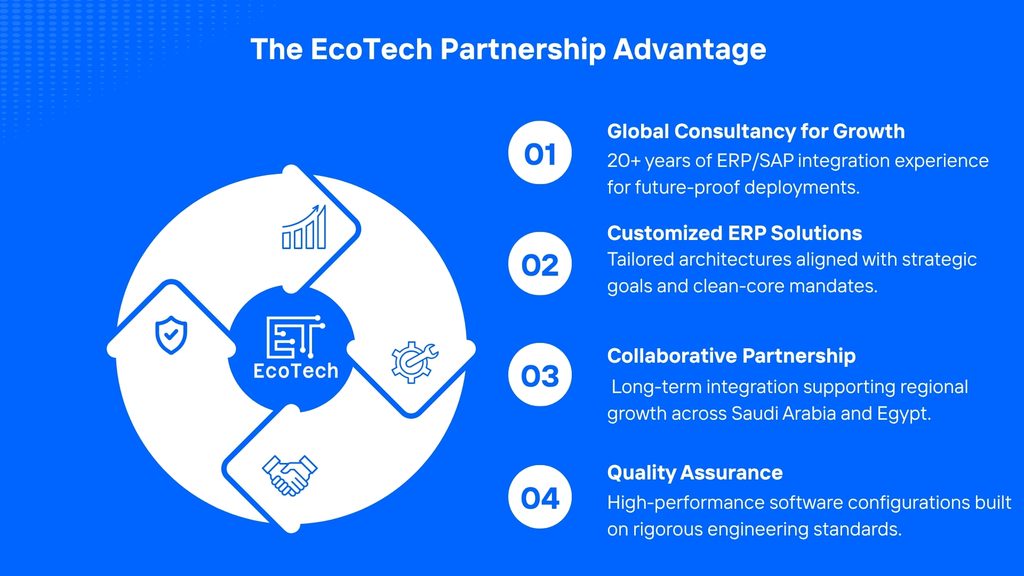
- Global Consultancy for Growth: Leveraging over 20 years of ERP and SAP® integration experience to deliver seamless, future-proof platform deployments.
- Customized ERP Solutions: Delivering tailored application architectures and extensions that address your organization’s precise strategic goals and clean-core mandates.
- Collaborative Partnership: Fostering long-term relationships by integrating directly into your ongoing business growth journey across Saudi Arabia, Egypt, and the broader region.
- Quality Assurance: Guaranteeing reliable, high-performance software configurations through rigorous engineering standards and deep ecosystem expertise.
Unlocking the true potential of your organization starts with empowering your teams to build smarter, faster, and more securely. By teaming up with EcoTech for your enterprise and cloud transformation initiatives, you ensure a smooth, friction-free rollout that maximizes your technology investment from day one.
Ready to transform your development landscape and drive sustainable, AI-powered business growth?
Get your FREE demo now: https://ecotech-mena.com/sap/request-a-demo/