What is a Clean Core Strategy in SAP?
A clean core is an SAP ® system kept as close to standard as possible, running the latest release, with extensions and integrations built in an upgrade-safe way.
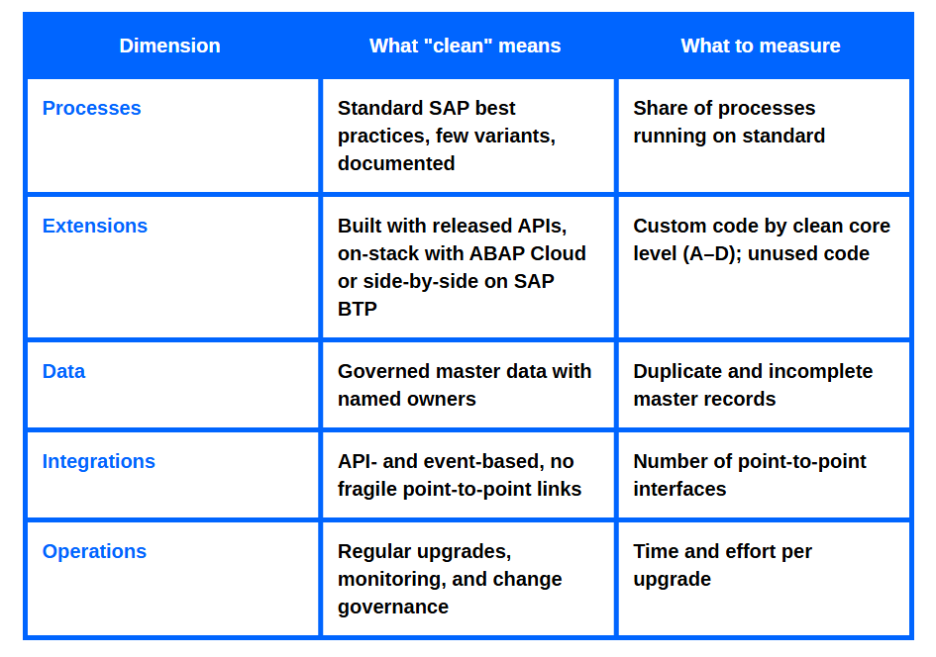
Many people think clean core only means “no custom code.” It’s broader than that. SAP defines the core across five dimensions: processes, extensions, data, integrations, and operations (SAP Learning). A system with zero custom code but dirty data and point-to-point interfaces is not clean.
Clean core also isn’t only for public cloud. SAP says the principles apply whether you run SAP Cloud ERP, the private edition, or on-premise (SAP Learning). Public cloud simply enforces it.
How SAP Now Grades Your Custom Code: Clean Core Levels A to D
SAP replaced its old three-tier extensibility model with the clean core level concept. Every extension is now graded from A to D based on how upgrade-safe it is (ASUG, SAP News).
- Level A: Built only with released, stable APIs (key-user tools, ABAP Cloud, SAP Build, or side-by-side on SAP BTP). Lowest upgrade risk—the target for all new work.
- Level B: Uses classic SAP APIs and technologies that are generally stable. Low upgrade risk—still counts as clean core.
- Level C: Uses internal SAP objects, tracked with a change log. Medium upgrade risk—”conditionally clean”, needs governance.
- Level D: Direct modifications to SAP standard code. High upgrade risk—not clean core.
An extension takes the level of its least clean part. One modification can drag a whole program to level D.
What to Do with Existing Custom Code
When moving from ECC to SAP S/4HANA, every custom object should be sorted into one of these paths:
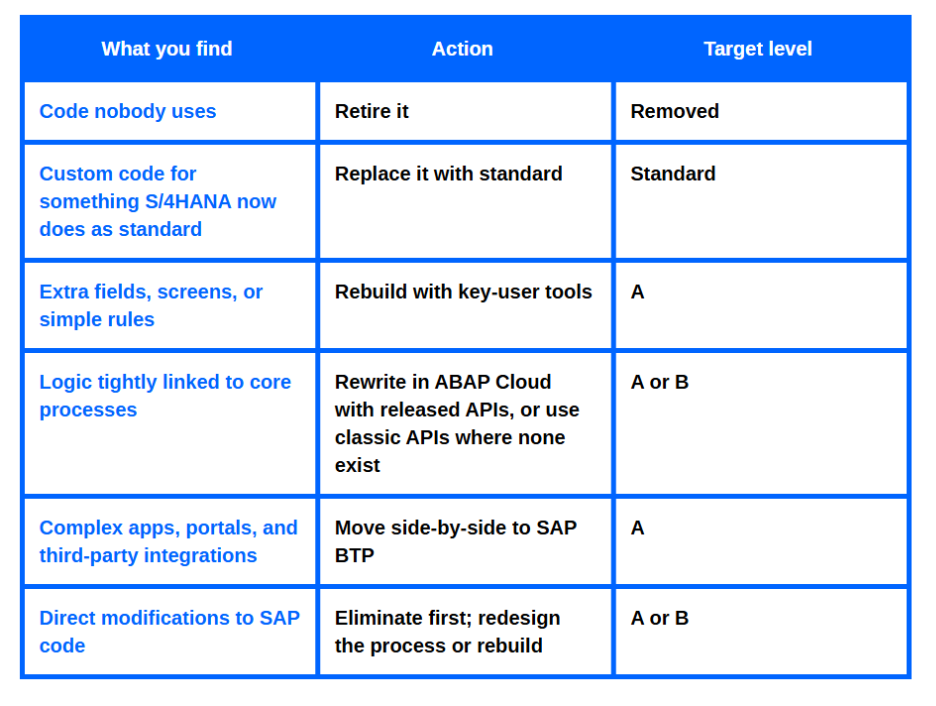
The first two rows usually cover a large share of a legacy system. The cheapest custom code to maintain is the code you delete.
Clean Core in Saudi Arabia, Egypt, and Kuwait
In this region, the most common excuse for custom code is local compliance: “SAP doesn’t handle our e-invoicing, so we built it ourselves.” Today, that’s usually no longer true.
- Saudi Arabia (ZATCA e-invoicing): SAP supports ZATCA e-invoicing through its standard Document Compliance solution. Every custom ZATCA program is code you must re-test with each ZATCA change and each SAP upgrade.
- Egypt (ETA e-invoicing): Egypt’s electronic invoice is available in SAP Document and Reporting Compliance, integrated through SAP Integration Suite. The standard route keeps compliance updates in SAP’s hands, not yours.
- Kuwait and regional groups: Family-owned groups often run each company with its own chart of accounts, its own reports, and its own custom code. A clean core sets one standard across entities, which is what makes faster consolidation and closing possible.
- Arabic and local reporting: Before building a custom form or report, check what the country version and standard output tools already cover. Many legacy Arabic reports were built before standard options existed.
The Rule of Thumb: If a regulation applies to every company in the country, SAP or a certified add-on probably covers it. Custom code should be reserved for what makes your business different.
Why Clean Core Efforts Stall
The technology to keep a core clean exists. What’s usually missing is the will to say no.
- Every department wants its own version: Sales wants a custom approval, finance wants a custom report, operations wants a custom screen. Each request is small. Together they rebuild the old system on new software.
- Nobody owns the “no”: Without a design authority that approves or rejects custom code, IT says yes to whoever pushes hardest.
- Data is migrated as is: Duplicate vendors, incomplete materials, and inconsistent cost centers are moved into S/4HANA unchanged, and the new system inherits the old problems.
- Clean core is treated as a one-time project: A core cleaned at go-live gets dirty again within a year unless upgrades, extensions, and data are governed continuously.
That’s why clean core is a leadership decision before it’s a technical one.
EcoTech’s 5-Stage Path to a Clean Core
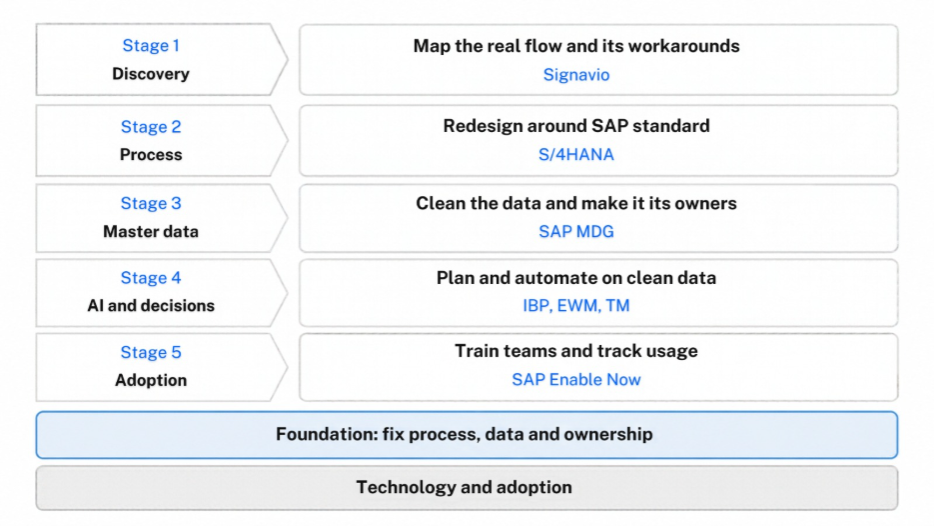
The same value chain EcoTech uses on every SAP project, applied to clean core. Stages 1 to 3 clean the core; stages 4 and 5 build on it and keep it clean.
- Business Discovery: Inventory your custom code, interfaces, and data issues, and grade each extension by clean core level using tools like Signavio and ATC.
- Process Re-Engineering: Run fit-to-standard workshops. Where SAP standard covers the need, the business adapts the process instead of SAP adapting the code.
- Master Data Management: Clean, deduplicate, and assign owners to material, customer, vendor, and financial master data before migration using SAP MDG.
- AI and Decision Enablement: Rebuild the extensions you truly need at level A, on-stack with ABAP Cloud or side-by-side on SAP BTP. Then turn on capabilities like SAP Joule on top of a clean system.
- Change and Adoption: Train key users on standard processes using SAP Cloud ALM, and set up a design authority that reviews every new custom request so the core stays clean.
Why EcoTech for a Clean Core with SAP

EcoTech is an SAP Partner with more than 20 years of ERP experience across Saudi Arabia, Egypt, and Kuwait.
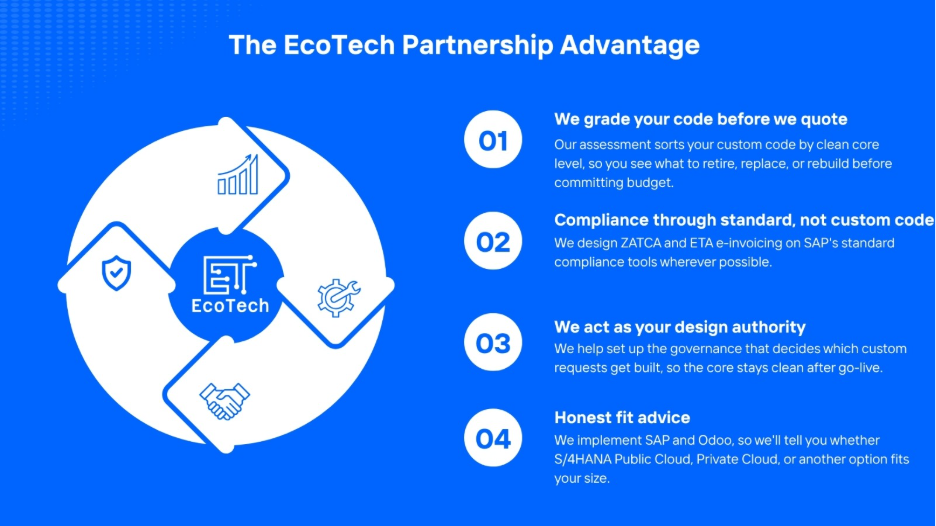
- We grade your code before we quote: Our assessment sorts your custom code by clean core level, so you see what to retire, replace, or rebuild before committing budget.
- Compliance through standard, not custom code: We design ZATCA and ETA e-invoicing on SAP’s standard compliance tools wherever possible.
- We act as your design authority: We help set up the governance that decides which custom requests get built, so the core stays clean after go-live.
- Honest fit advice: We implement SAP and Odoo, so we’ll tell you whether S/4HANA Public Cloud, Private Cloud, or another option fits your size.
How Clean Is Your SAP System?
Book a free 30-minute clean core readiness assessment. You’ll leave knowing roughly how much custom code you can retire, where your biggest data and integration risks are, and a realistic path to S/4HANA.
Book your free discovery session
Frequently Asked Questions (FAQ)
What is a clean core strategy with SAP?
It means keeping your SAP system as close to standard as possible, on the latest release, with upgrade-safe extensions and integrations, governed data, and standard processes.
What are the SAP clean core levels?
SAP grades extensions from A to D. Level A uses only released APIs, B uses classic stable APIs, C uses internal SAP objects with governance, and D means direct modifications, which are not clean core.
Does clean core mean no custom code at all?
No. It means custom code is built in an upgrade-safe way and kept only where it gives a real business advantage.
Does clean core apply to SAP S/4HANA Private Cloud and on-premise?
Yes. SAP applies clean core principles to all deployment options. Public cloud enforces them; private cloud and on-premise rely on governance.
What happens to our custom ABAP code when we move to S/4HANA?
It’s analyzed and sorted. Unused code is retired, standard features replace duplicates, and what remains is rebuilt with key-user tools, ABAP Cloud, or SAP BTP.
Can we meet ZATCA and Egypt ETA requirements without custom code?
In most cases, yes. SAP covers both through its standard Document and Reporting Compliance solution.
Why does clean core matter for AI like SAP Joule?
AI agents need standard processes and reliable data. Heavy custom code and dirty data limit what they can read and do.